The United States logged 27 separate billion-dollar weather events in 2024 alone [1], but the headlines barely scratch the surface. Earthquakes in Japan, monsoons in South Asia, and record floods in Europe create the same one-two punch worldwide: infrastructure damage followed by opportunistic fraud. Whether we’re mapping supply-chain weak points for a Tokyo manufacturer or vetting relief invoices for a Texas insurer, the investigative playbook—and the stakes—remain universal.
Before the Sirens: Intelligence-Driven Preparedness
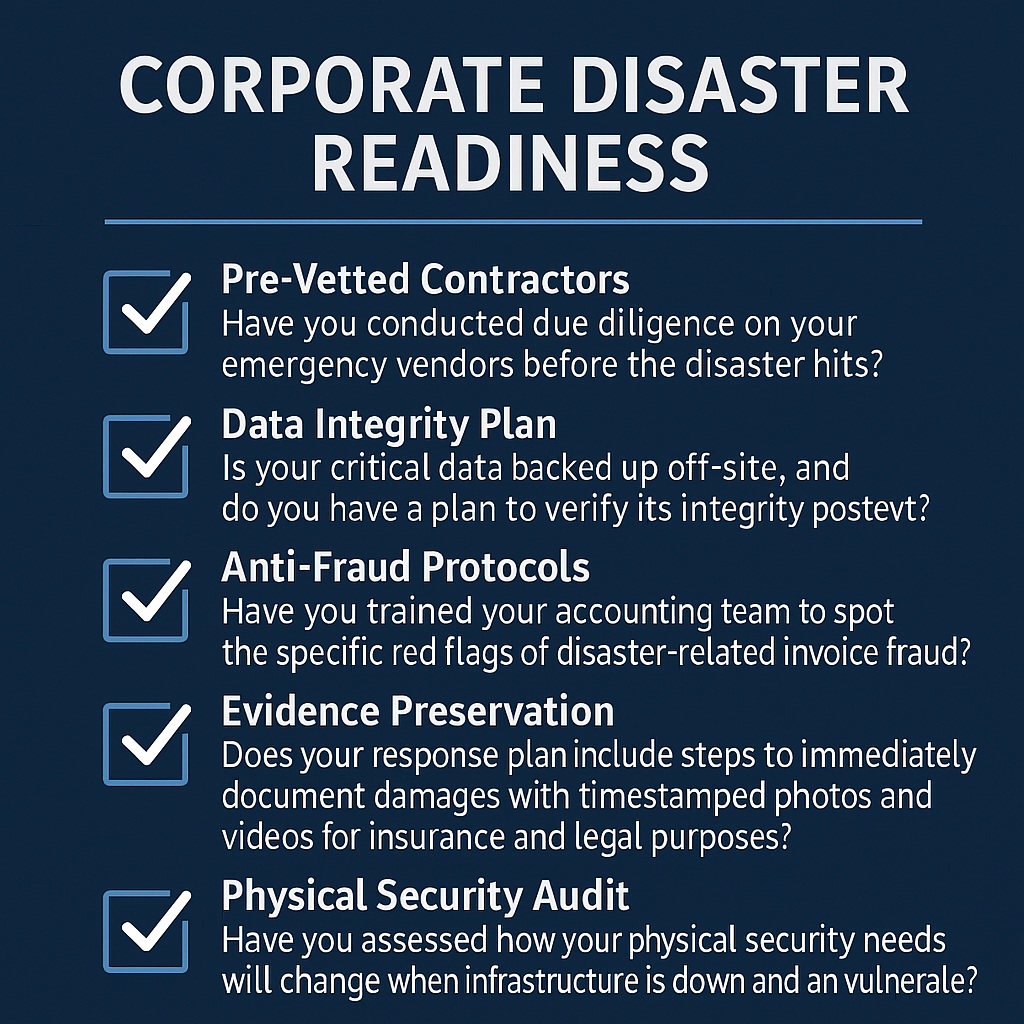 We embed with business-continuity teams long before the sky turns green:
- Threat-surface mapping. We layer global hazard data, critical-infrastructure overlays, and dark-web chatter to spotlight flood-prone server rooms, wildfire corridors, or strike-prone ports.
- Vendor & contractor due-diligence. Accelerated background checks, license verification, and litigation histories keep bad actors out of rebuild contracts.
- Counter-fraud controls. Mirroring National Center for Disaster Fraud (NCDF) and similar international typologies, we help finance teams quarantine suspicious invoices instantly [2].
- Data-integrity playbooks. We advise IT on off-site imaging and evidentiary hash policies, ensuring digital proof survives wind, water, or ransomware.
Impact Phase: Eyes and Ears on the Ground
When first responders are maxed out, we deploy rapid-response teams:
- Secure-scene entry via FEMA ICS or equivalent international credentials.
- Drone & sensor sweeps delivering high-resolution imagery that engineers and insurers can parse in hours.
- Witness coordination using trauma-aware interviews to preserve fragile memories.
Recovery & Investigation: Turning Rubble into Evidence
Fraud spikes within 72 hours of landfall [2], so speed matters:
- Fraud-pattern analytics match invoices, GPS logs, and contract awards to flag phantom work crews.
- Supply-chain tracing follows relief money through shell LLCs using link-analysis software recommended by RAND’s recovery financing guide [3].
- Expert testimony translates drone footage and forensic spreadsheets into plain-English narratives judges and juries grasp.
Mini-Case Study: The Phantom Debris Haulers
After a historic river flood, a municipality approved a multi-million-dollar debris-removal contract. Our client, an insurer, smelled trouble. We cross-matched the contractor’s invoices with truck-GPS logs and flew our own drones to volumetrically measure debris piles. Result? Over 2,000 “phantom” truckloads uncovered. The evidence saved the insurer millions and triggered a federal fraud probe.
Proactive Services That Pay for Themselves
Prevention beats litigation every time:
- Climate-risk audits before site expansions or M&A deals.
- Employee training to spot disaster-aid phishing scams.
- Live asset-tracking dashboards overlaying fleet GPS with global hazard maps, echoing GFDRR’s private-sector framework [5].
Continuous Improvement
After-action reviews slash confusion in real events [4]. We facilitate multidisciplinary debriefs—legal, HR, ops—then bake lessons into updated continuity plans, insurance riders, and vendor rosters.
When every minute counts and every invoice is under a microscope, having PIs on speed-dial isn’t a luxury—it’s operational insurance.
Reference List
- NOAA National Centers for Environmental Information. “U.S. Billion-Dollar Weather and Climate Disasters.” Updated 2025.
- U.S. Department of Justice, National Center for Disaster Fraud. Press Release: “Fraud Awareness in the Wake of Hurricane Helene.” 4 Oct 2024.
- RAND Corporation. “What Role Does the Private Sector Have in Supporting Disaster Recovery Financing?” Perspective PE-187, 2022.
- XPressGuards. “The Role of Security Guards in Disaster Management.” 2023.
- Global Facility for Disaster Reduction and Recovery (GFDRR). “Private Sector Participation in Disaster Recovery and Mitigation: Guidance Note.” 2020.