A 2024 Financial Action Task Force brief pegs environmental crime at USD 110 – 281 billion per year—now the world’s fourth-largest illicit market [1]. Wildlife trafficking alone is worth up to USD 20 billion annually [2]. Yet INTERPOL’s Environmental Security Programme fields just four specialized teams—Forestry, Fisheries, Pollution, and Wildlife—to cover 196 member nations [3]. Private investigators fill the bandwidth gap, bringing rapid-response mobility and civil-law leverage that public agencies can’t always deploy.
Why Private Investigators Matter
Government task forces are stretched; corporate compliance desks are often reactive. We step in to:
- Mobilize instantly. No waiting for budget cycles or inter-agency MOUs.
- Bridge jurisdictions. Our licensing network keeps the chain of custody intact across borders.
- Supply civil leverage. Evidence we secure fuels injunctions, shareholder suits, and insurer subrogation—pressure points that can curb damage faster than criminal courts alone.
Our Tool Kit in the Field
Remote sensing & drones reveal illegal clear-cuts and night-time discharge pipes.
Data & financial forensics track shell companies, falsified manifests, and crypto payoffs.
Covert surveillance & sampling catch PFAS effluent and other “flush and dash” tactics in real time.
Witness coordination employs trauma-aware interviews to protect whistle-blowers while preserving testimony.
Proactive Shield: Environmental Due Diligence
While we’re often called after smoke rises, the best play is prevention. We:
- Conduct pre-acquisition environmental due-diligence that flags hidden liabilities before a deal closes.
- Run supply-chain audits to verify legal and ethical sourcing.
- Design internal monitoring programs—sensor arrays, random sampling schedules, whistle-blower hotlines—that spot anomalies long before regulators do.
An ounce of due-diligence costs far less than a multi-million-dollar cleanup, fine, or brand meltdown.
Warning Signs Corporations Shouldn’t Ignore
- Sudden spikes or drops in waste-management costs.
- “Too good to be true” raw-material prices.
- Repeated effluent-limit violations followed by suspicious data-logger “failures.”
- Anonymous tips describing after-hours activity.
Early investigation turns red flags into course corrections instead of courtroom exhibits.
Case Vignette: Ghost Timber, Real Consequences
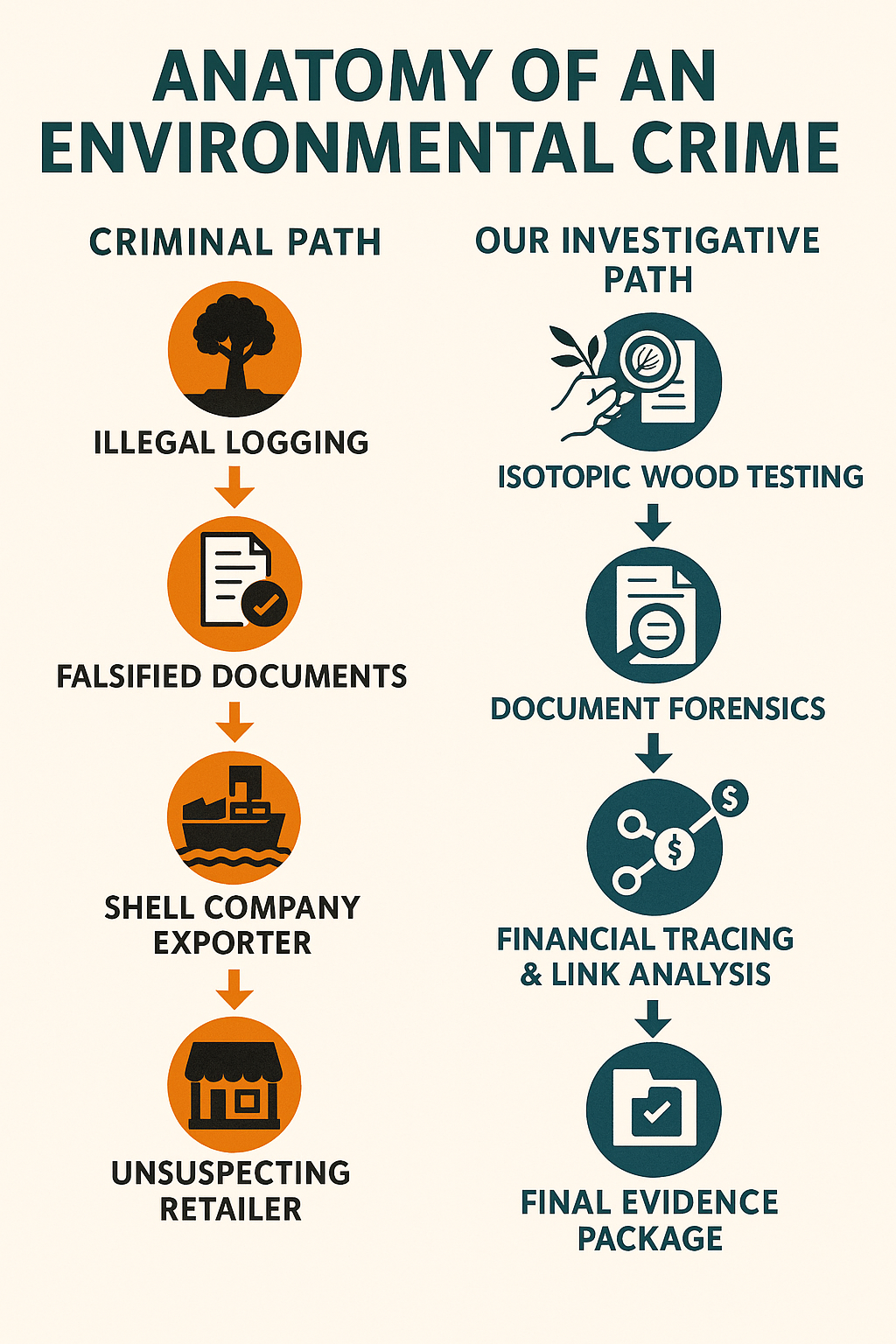 A furniture brand was accused of using teak logged inside a protected Southeast-Asian reserve. We traced paperwork anomalies, deployed isotopic wood testing, and built a GPS-tagged chain-of-custody audit. Customs seized two container loads; the company revamped its supplier vetting. Forest—and shareholders—both won.
From the Field to the Witness Stand
Collecting isotopic data or multispectral drone imagery is only half the battle. Our investigators are trained expert witnesses who translate lab results into plain-English narratives for judges and juries. Whether it’s explaining PFAS chemistry or blockchain-based timber tracing, we make sure the evidentiary punch isn’t lost in technical jargon.
Partnering for Impact
- Law firms & general counsel receive affidavit-backed exhibits ready for discovery and Daubert scrutiny.
- Regulators & prosecutors gain clean, well-documented evidence that accelerates charging and settlement timelines.
- NGOs & impact investors get independent verification that strengthens ESG screens and advocacy campaigns.
Communities First: Environmental Justice
The U.S. EPA closed FY 2024 with 485 open criminal environmental investigations, most in already over-burdened communities [4]. We translate complex findings into town-hall-ready language so residents can advocate effectively.
The Road Ahead
Policy analysts warn the true societal cost of environmental crime may top USD 1 trillion annually [5]. Whether it’s tracking an oil-spill plume by satellite or unmasking an illegal waste-export ring, we’re ready to put boots—and drones—on the ground for conservation.
Reference List
- Financial Action Task Force (FATF). “Environmental Crime.” FATF-GAFI.org. fatf-gafi.org
- INTERPOL. “Wildlife Crime.” interpol.int. interpol.int
- INTERPOL. “Environmental Crime Partnerships: Four Specialized Working Groups.” interpol.int. interpol.int
- U.S. Environmental Protection Agency. “Enforcement and Compliance Assurance Annual Results for FY 2024—Criminal Enforcement.” epa.gov, December 2024. epa.gov
- FACT Coalition. “Environmental Crime & Illicit Finance Policy Brief.” August 2024. thefactcoalition.org
- UNEP & INTERPOL. “The Rise of Environmental Crime.” Rapid-Response Report, 2016. unep.org