1. Phony “Delivery Failure” Texts
Fraud rings text you a fake tracking link that harvests payment credentials, then raid your loyalty-points wallet (often worth more than the parcel itself).
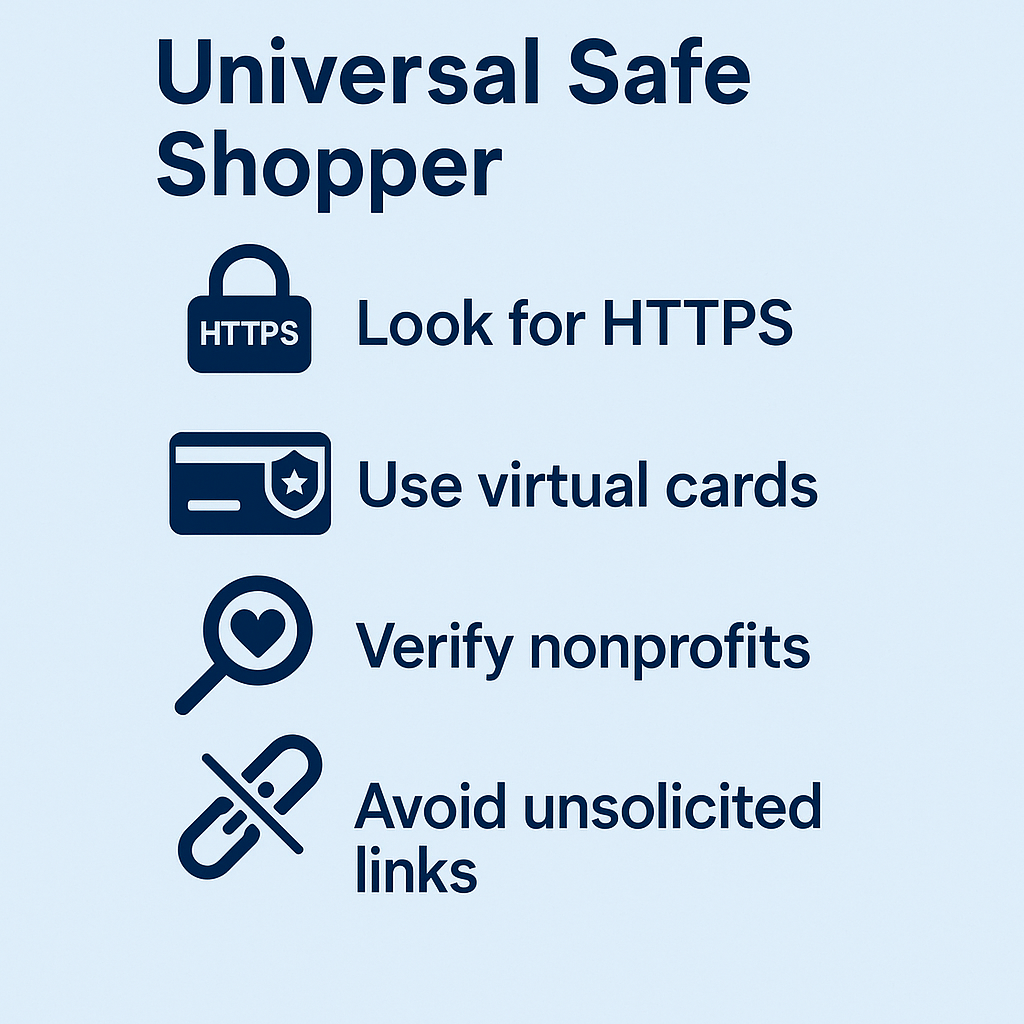
Your move: Never click a shipping link you didn’t request. Type the carrier’s address manually and use the tracking number from your original order.
2. Flash-Sale Spoofs & Counterfeit Stores
Visa’s 2025 global fraud brief reports that 39 % of fake sites imitate just ten brands [4].
Your move: Check domain age via WHOIS, use virtual card numbers that cap charge amounts, and avoid “exclusive” links shared only on social.
3. Heart-String Charity Fraud
Scammers cloned donation pages and phone appeals to skim US $133 million worldwide in 2024 [5].
Your move: Verify nonprofits on Charity Navigator, Guidestar, or your country’s charity register; donate directly through the official site.
4. Gift-Card Payment Demands
Retailers sold US $38 billion in gift cards last year, providing scammers with untraceable pseudo-cash [6].
Your move: Treat gift cards like cash—never email or text their numbers to anyone.
5. Holiday Travel Bait-and-Switch
Fake villa listings and airline-support scams surge every December; 18 % of travellers encountered a fraudulent booking site in 2024 [7].
Your move: Book via reputable platforms with payment protection; obtain support numbers from the official app, not a web search ad.
6. The Fake “Customs Fee” Ploy
You order a gift from overseas, then receive an email claiming your parcel is “held by customs” pending a small release fee. The link siphons your card details. INTERPOL flagged this scam across 60 countries in 2024 [8].
Your move: Never pay duties through an unsolicited link. Visit the carrier’s official site (DHL, FedEx, Japan Post) and enter your real tracking number.
Case Vignette: The US$9,600 “Santa Express” Skimmer
 A boutique merchant hired us after 240 customers reported missing orders. We found a Magecart skimmer that redirected checkout traffic to a look-alike page. Coordinating with the payment processor, we captured server logs and live fraud transactions, then handed an evidence package to INTERPOL’s cyber-intelligence desk. Ten days later the ring was dismantled and the merchant earned PCI-forensic clearance—saving both revenue and reputation.
Your January Financial Health Check (Global Edition)
- Scrutinise statements: Review all card and bank activity for unfamiliar charges.
- Report fast: Dispute suspicious debits with your issuer immediately—charge-back windows differ by country.
- Rotate passwords: Change credentials for any account that touched holiday shopping.
- Pull your credit file: Many jurisdictions let you request a free or low-cost credit report; look for surprise accounts in your name.
Where We Come In
From rapid incident response and blockchain asset-tracing to pre-season pen-testing and employee awareness drills, we turn holiday havoc into a secure January. If the scammer’s sleigh already slipped past the gate, we can still track the loot—and testify in court when needed.
Reference List
- U.S. Federal Trade Commission. “Consumer Sentinel Network Data Book 2024.” February 2025.
- Kaspersky Lab. “Global Holiday Phishing Landscape 2024.” January 2025.
- Europol. “Internet Organised Crime Threat Assessment (IOCTA) 2024.” September 2024.
- Visa Inc. “2025 Global Holiday Fraud Report.” April 2025.
- Charities Aid Foundation. “Global Giving Trends 2024.” October 2024.
- National Retail Federation. “2024 Gift Card Spending Survey.” January 2025.
- AARP. “Holiday Travel Fraud Survey.” December 2024.
- INTERPOL. “Customs Fee Text Scam Alert—Global Advisory.” December 2024.